Garage Door Not Opening in Cold Weather? Here's Why (Ottawa Guide)
When the temperature plunges, garage doors across Ottawa start acting up — here's what's actually going on and what you can do about it.
Introduction
If you've ever stood in your driveway on a minus-twenty-five morning, pressing the remote over and over while your garage door refuses to budge, you're far from alone. Every winter, Ottawa homeowners from Orléans to Stittsville deal with garage doors that suddenly stop cooperating the moment the mercury drops. It's such a common seasonal complaint that it's worth understanding exactly why cold weather causes so many garage door problems.
The mechanics are straightforward once you understand them: metal contracts in the cold, lubricants thicken, plastic components become brittle, and ice and snow physically interfere with moving parts. None of these issues are unique to any one brand or door type — they affect virtually every garage door in the region to some degree, which is why this is one of the most common service calls we see between December and March.
This guide walks through the most likely causes of a cold-weather garage door failure, quick checks you can do safely, and when it's time to stop troubleshooting and call for help.
Common Cold-Weather Causes
Frozen or Icy Bottom Seal
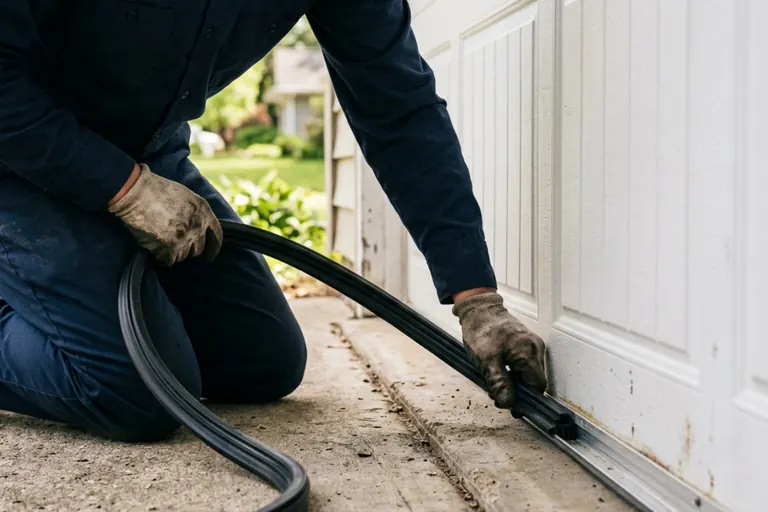
One of the most frequent culprits is the bottom weatherstripping freezing to the driveway or garage floor overnight. If there was any moisture on the ground when the door last closed, it can freeze solid, effectively gluing the door shut. This is especially common after a freeze-thaw cycle, which Ottawa experiences often through the shoulder seasons.
Thickened Grease and Lubricant
Old or lower-quality lubricant on tracks, rollers, and hinges thickens significantly in extreme cold, adding enough resistance that the opener's motor can't generate enough force to move the door, or the safety mechanism senses excess resistance and stops the door as a precaution.
Contracted Metal Components
Steel tracks, springs, and hardware all contract slightly in cold temperatures. In a door that's already slightly misaligned or has springs nearing the end of their life, this contraction can be enough to cause binding or uneven movement that prevents normal operation.
Weakened or Broken Springs
As covered in more detail elsewhere, cold makes springs more brittle and prone to failure. A spring that was barely hanging on in the fall may finally give out during a hard freeze, leaving the door too heavy for the opener to lift.
Battery and Electrical Issues in the Opener
Extreme cold reduces battery performance, which can affect battery backup systems and even wall-powered openers if there are underlying electrical issues. Remote batteries also drain faster in cold weather, which is sometimes mistaken for a bigger mechanical problem.
Snow and Ice Blocking the Track or Sensors
Snowbanks pushed up against the garage door, or ice accumulation directly in the tracks, can physically prevent the door from traveling. Ice or snow covering the photo-eye safety sensors can also cause the door to refuse to close, or stop partway through its cycle.
Safe Troubleshooting Steps
Check for Visible Ice Buildup First
Before trying to force anything, look along the bottom seal, in the tracks, and around the sensors for visible ice or snow. Gently clearing this with a plastic scraper (never metal, which can damage seals or tracks) often resolves the issue immediately.
Try the Manual Release Carefully
If the opener isn't responding, you can try the manual release to see if the door moves freely by hand. If it feels extremely heavy or won't budge, stop — this points to a spring issue rather than a simple cold-weather glitch, and forcing it further risks injury or damage.
Inspect and Replace Remote Batteries
If only the remote seems affected and the wall control still works normally, cold-drained batteries are a likely and easy fix.
Warm the Garage If Possible
If you have a heater or heat lamp safely available, gently warming the immediate area around the tracks and bottom seal can help thaw minor ice without resorting to force.
Don't Keep Forcing the Opener
If you've pressed the remote multiple times with no result, stop. Repeated attempts can burn out the opener's motor or strip gears, turning a simple cold-weather glitch into a more expensive repair.
When Cold Weather Points to a Bigger Problem
If clearing visible ice and checking batteries doesn't resolve the issue, the cold snap may simply be the trigger that exposed an underlying problem — a weakening spring, worn cables, or an opener that was already on its last legs. Ottawa's temperature swings have a way of finding the weakest link in any mechanical system, and garage doors are no exception.
Frequently Asked Questions
Why does my garage door work fine most of the winter but fail during the coldest snaps?
Extreme cold amplifies existing weaknesses. A door with slightly worn springs or thickened old lubricant might function fine at minus five but struggle at minus twenty-five, when contraction and stiffness are at their peak.
Is it bad to force my garage door open manually if it's frozen shut?
Yes, forcing a frozen door can damage the weatherstripping, bend the track, or strain the springs and cables. It's better to carefully clear visible ice first and avoid excessive force.
Should I leave my garage door opener plugged in during a power outage?
Openers with battery backup will operate briefly during an outage, but repeatedly relying on this to lift a heavy, cold-stiffened door isn't ideal. If the outage is extended, use the manual release with care.
Can I prevent cold-weather garage door problems altogether?
Regular maintenance — proper lubrication before winter hits, clearing snow and ice promptly, and addressing worn seals early — significantly reduces the chances of a cold-weather breakdown.
When to Call a Pro
If you're in Ottawa or the surrounding area and your garage door won't open in cold weather, reach out to 613 Garage Door Repair. Call (613) 709-2979 — we're open 7 days a week, 7 AM to 9 PM, with 24/7 emergency service across Ottawa, Kanata, Nepean, Orléans, Barrhaven, and beyond.
Need help with your garage door?
613 Garage Door Repair is open 7 days a week, 7 AM–9 PM, with 24/7 emergency service across Ottawa and the surrounding region. Call (613) 709-2979 for same-day service and a free written estimate.